According to the UN approximately 1.3 billion tons of food, including fruits and vegetables are lost and wasted worldwide annually, most before getting to the final consumer. Due to the Italian regulation of Street Markets, fresh products remaining unsold at the end of the day must be thrown away. Even before the pandemic Street Markets had been struggling due to: -Dependency on the regulations taken by the municipality -Losing clients to online shopping services and big chains of supermarkets. The pandemic brought them new issues: -Lacking skills and economic support required to adapt their activities. -Customer flow reduced due to regulations and restrictions. -Deliveries require a minimum purchase of 50 € to be worth it. Street markets fail to reach younger generations because of their consumption habits: -Preferring digital over physical purchases. -Often do their groceries on their way back home from university/ work. -Do small groceries since they live by themselves.
HiddenMarket is a service that connects different stakeholders from italian cities to save food, support small businesses, and improve food consumption of younger generations.
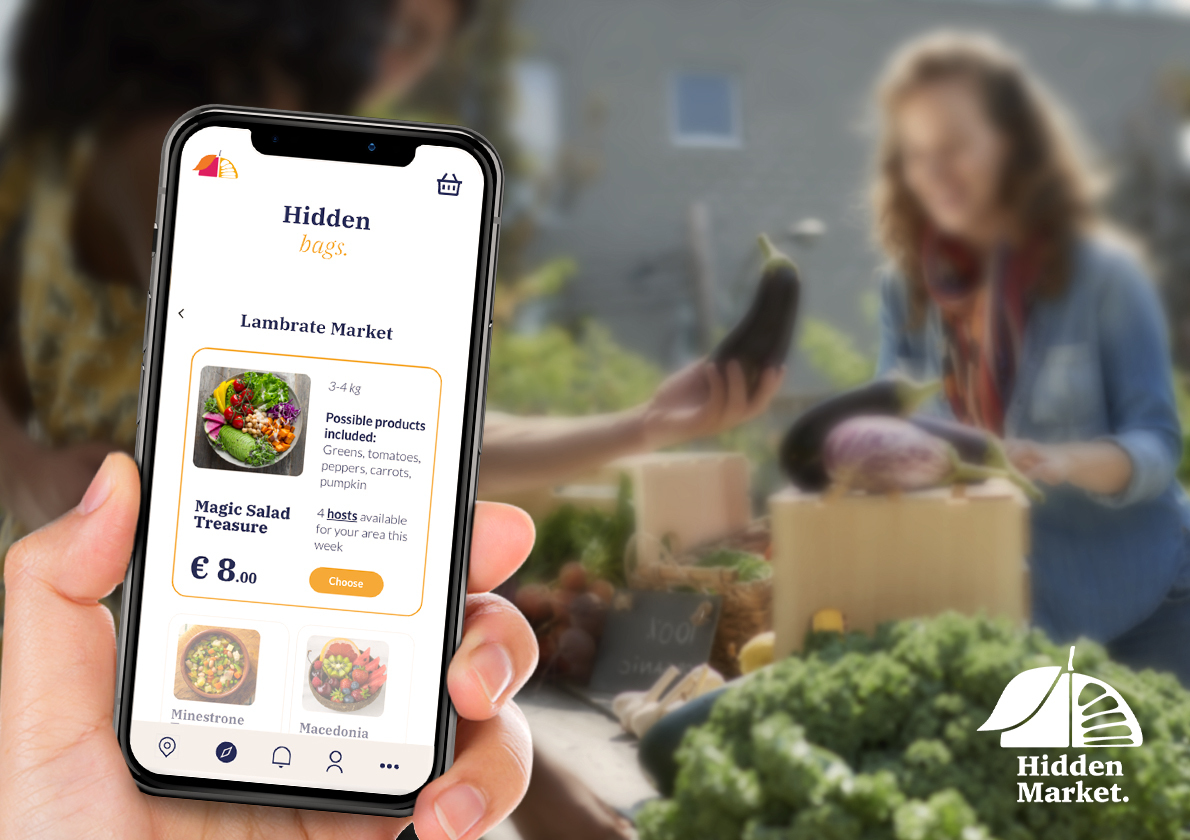
The service saves food from street markets and sells it in different categories of bags through its online platform. The bags are made of seasonal products and although there’s some level of uncertainty in the products users can obtain, they can choose the type of bag they want between Macedonia, Magic salad, Back to basics, Minestrone and Mystery bag, each defining a range of products the user may receive. Users can either make single purchases of bags or choose to Adopt the saved food, through a monthly or annual subscription to the service, receiving a weekly delivery.
HiddenMarket also aims to transmit the knowledge and values of the market through its online and offline channels. Within the app and the website, users can find recipes and tips to keep their food fresh for a longer time, as well as advice about how to make the most of it using every bit of their fruits and veggies. In addition, they will receive printed postcards with information about their closest market, the vendors who work there, and the food they sell. The objective is to communicate the value of the markets, putting them closer to the users by telling stories and thus increasing the interest towards the open markets. Furthermore, HiddenMarket seeks to transmit sustainable practices, cooking advice and other information that helps users adopt healthier and more sustainable behaviors without making many compromises.
The service requires the partnership and participation of street markets and small businesses such as: tabaccherie, edicole, fiorai. etc; found in most neighbourhoods around Italy, the use of their facilities and logistics.One of the expected outcomes of the service is the making of a strong network inside of neighbourhoods, in which small businesses are kept vital and useful, and whose stakeholders get to develop important collaboration relationships.
This is the reason why cooperation and trust is essential for HiddenMarket, without the support of the neighborhood nets, it wouldn’t be possible to make the service real. In this sense, communication will be focused on the experiences and characteristics of each neighborhood and will be as close as possible to the people living in that area and to its market.
An important percentage of the annual earnings will be destined to the market’s associations that take part in HiddenMarket, to give extra economic support to vendors, that may be used to improve the markets offering and face unexpected drawbacks.
HiddenMarket is thought to be a Social Business, and therefore its remaining revenue is destined to improve and scale up the service and therefore saving more food and helping more markets.
The objective is to cover in the first year around 20 markets from Milan, after 3 years start scaling to new cities in Italy (Torino, Firenze, Roma), and after 5 years replicating it through different cities around Europe.